
Are you a plotter, carefully planning your novel, or a pantser, discovering your story as you go along?
Twelve years ago, I stumbled across the story of some 300 Swiss Anabaptists who were exiled to the Low Countries in 1711. What had happened to them? How had they come to leave their beautiful mountains and homeland, banished forever? And how had they adjusted to life in the grim, impoverished peat districts of the Low Countries?
Somewhere along the line, I caught a bug of the writing kind. Convinced that their experiences would make a great novel, I began researching the circumstances surrounding their exile, collecting so many dates, names and historical facts that it all became rather a muddle.
Enter a snazzy bit of software called Aeon Timeline, which allowed me to create as many timelines as I wanted.
Cue more reading, more research, and quite a few more books. Starting with the history of the Anabaptists in Switzerland, I soon branched out into the history of the Low Countries. I discovered books containing extraordinary amounts of information about the exiled community who had settled in my ancestral village. Gradually, I began building timelines for the historical events, alongside others for Anna, the heroine of my story, and the fictional characters whose lives would become entwined with those of the exiles.
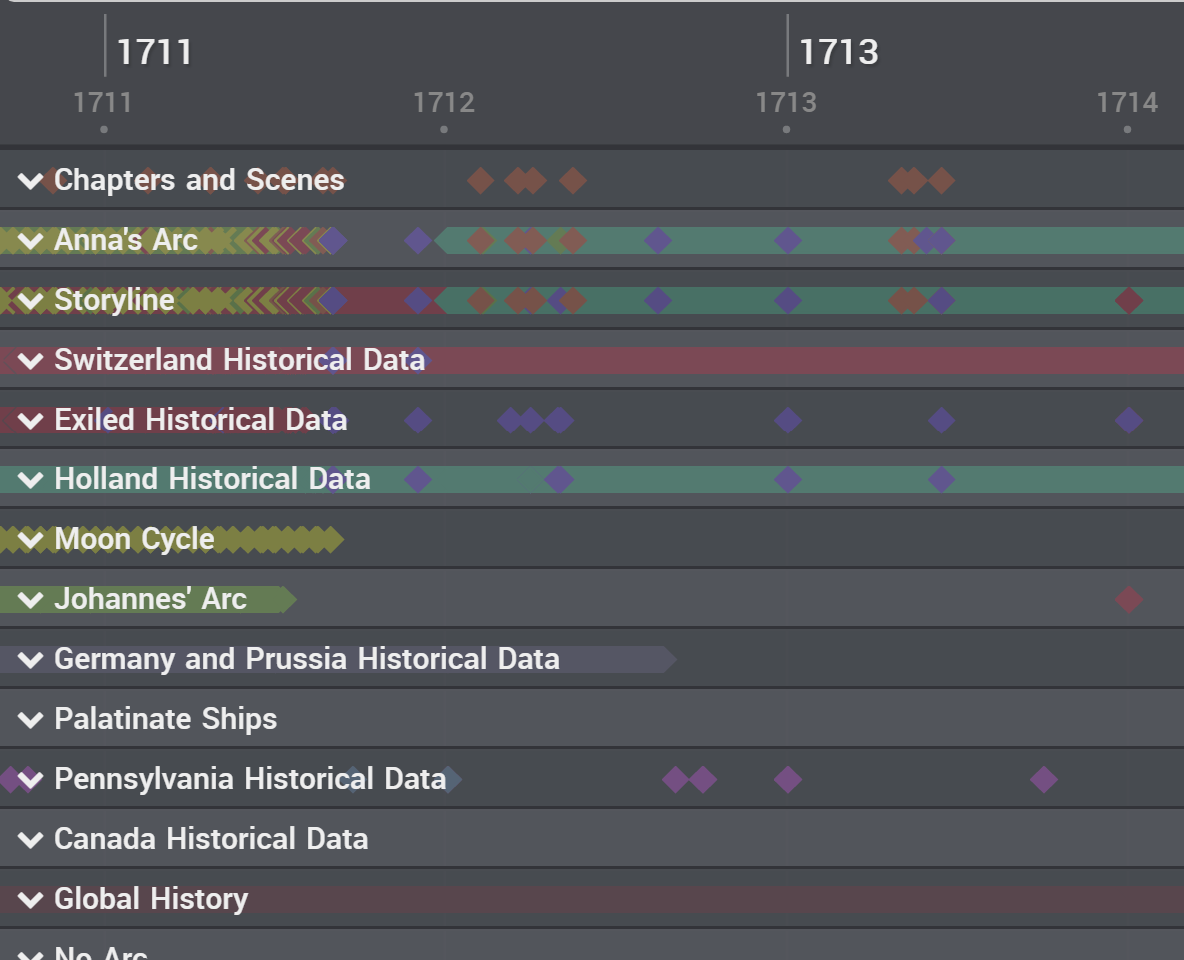
My Aeon Timeline — including, yes, the phases of the moon!
The problem with writing about real people was that I felt a genuine responsibility towards those whose experiences inspired my novel. I couldn't, and didn't want to, invent the circumstances in which they found themselves.
Down the Research Rabbit Hole
And historical authenticity isn't simply about getting the dates right. If I was going to do justice to these people, I needed to understand not just who they were, but how they lived, both in the Bernese Alps and in the Low Countries.
Cue more research, this time of a more hands-on variety.
I learned to spin and weave, studied eighteenth-century farming practices in the Bernese Alps, and discovered how cheese was made back then. On holiday, we stayed in an old Swiss hut dating from 1734 — about as close to 1711 as I was ever likely to get! It stood in a village neighbouring the one I was researching, its furniture covered in ancient cobwebs, and the whole place smelling of centuries-old dust and must. We also visited the old prison cells where notches scratched into the walls showed just how long some Anabaptists had languished there.
Every new discovery found its way into my research, and often into Aeon Timeline. And I may have taken my fascination with historical accuracy a little too far.
Apparently, knowing what day it was wasn't enough. I needed to know what the moon was doing as well.
Funnily enough, you can find that out on the internet too. It was a bit mad, but at least if you read that the moon was waning, you can be certain that it really was!
So far, so much plotting.
But there comes a point when historical frameworks can begin to feel restrictive. My fictional story had to fit within the circumstances of real events, and I couldn't simply rearrange history to suit my characters. I was both inspired and constrained by that framework, but it helped me remain as faithful as possible to the experiences of the people whose story I wanted to tell.
Discovering My Inner Pantser
Then came Pennsylvania.
I chose to set the final part of the novel across the Atlantic, and it was there that I discovered how much I enjoyed the freedom of being a pantser.
There was still plenty of historical research to keep me grounded. I can't begin to tell you how long I pored over old maps, working out exactly where certain events might have taken place. But with fewer constraints imposed by the documented lives of the exiles, I found a wonderful freedom to follow my imagination and allow the story to develop.
It was a chance to bring the novel to its conclusion, drawing together its strands of overcoming adversity, enduring love and, above all, the importance of community.
So I guess I'm both a plotter and a pantser. Although anyone who's seen my timeline of eighteenth-century lunar cycles might beg to differ…
Are you a plotter, a pantser, or somewhere in between? I'd love to know how you approach writing.
