
Finding Anna
By 2014, I’d been researching the lives of the Swiss Anabaptists for well over a year. As a Dutch and English speaker, with a reasonable reading level in German, there was a huge amount of material at my disposal.
For starters, the Dutch authorities of the early 1700s had kept meticulous records of the exile. Every person going into exile was accounted for: their name, age, where they came from, whether they were married, and whether they had a profession. All of it was recorded. They even noted precisely how much money the local Baptist community had raised and, over the years, accounted for every Thaler spent.
Then there were the books. A History of the Bernese Anabaptists, which the author John Gingerich kindly signed for me; a double bill of Documents of Brotherly Love by Lowry; Unser Leit, the Story of the Amish by Leroy Beachy; and many more. Together, they provided a wonderful backdrop to the story I was cooking up in my head. It would be a more personal one. Not a history lesson, but a story told through the eyes of those who were exiled.
Using my five blue books, I religiously tracked each family from Switzerland to the Low Countries, creating maps showing who lived where, and entire spreadsheets of who belonged to which family and who was connected to whom. Deep down, I just knew there was a story, but how do you tell one about the lives of real people? I wanted to remain truthful to their experiences, but trying to build a novel entirely around real lives felt too restrictive. I struggled to find a way in.
The breakthrough came when I spotted the name of a young woman on the register of one of the four boats. She’d been entered under two different names: Anna Kuentzy and Anna Seiler (Zahler).
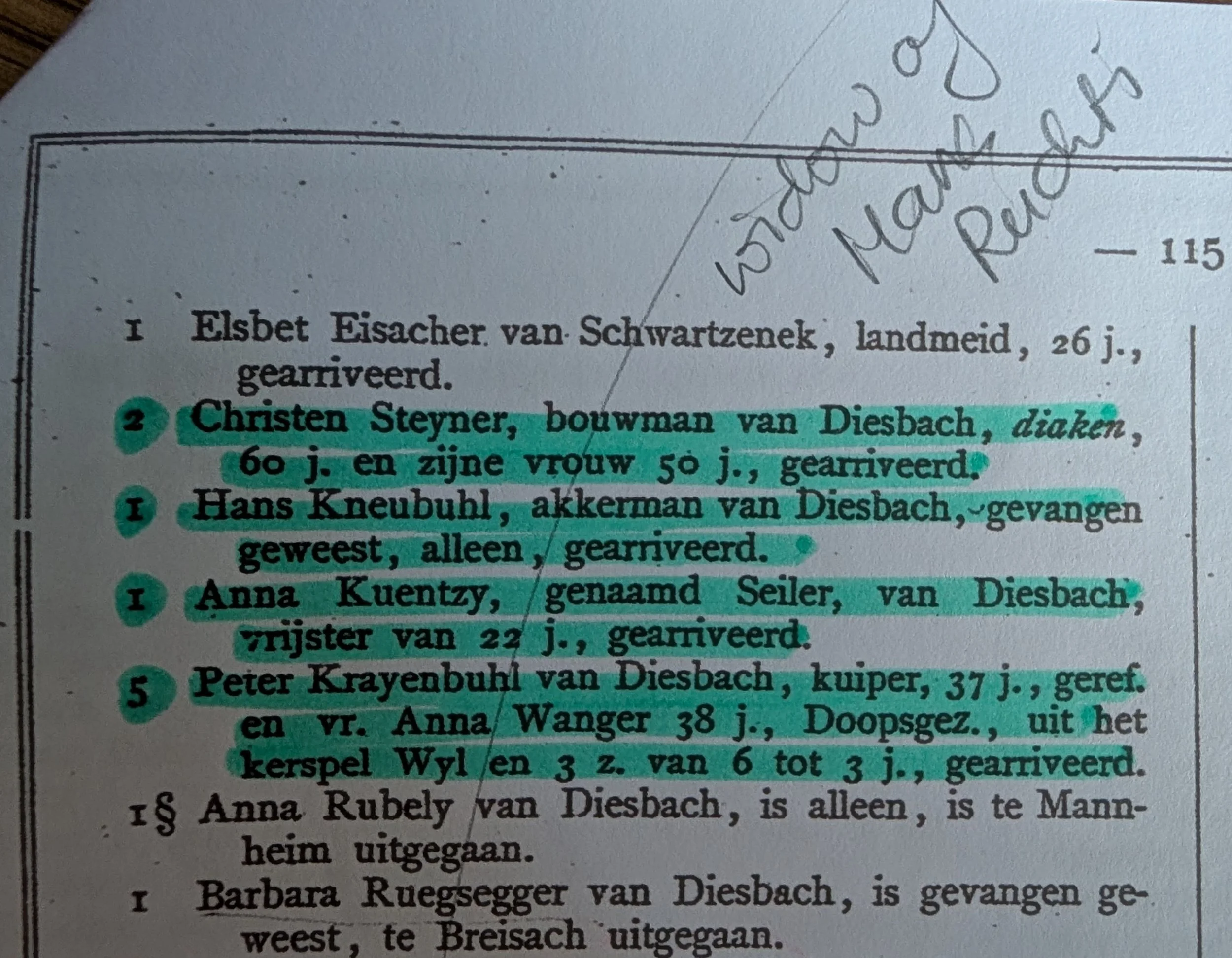
It was odd.
She was single, so the second name wasn’t a married name. Why two names?
I dug around for a while longer. Anna Kuentzy cropped up in later references. I discovered that she’d married, and even found when and where she died. But the life I could trace for her wasn’t the story that had begun to form in my head.
However hard I looked, I could find no further mention of someone called Anna Zahler. She simply did not appear anywhere. Could there have been a mistake? Or could they have been two different people?
What if…
It was the opening I needed.
What if the person taking the register had made a mistake? What if there had been someone called Anna Zahler? What if she too had gone into exile? What would her backstory be? Why would she have travelled on her own? How would she have lived among her fellow exiles? What might she have experienced?
Suddenly, I had the freedom to write about all those who had left the Bernese Oberland and gone into exile. Telling the story through Anna’s eyes, I could stay true to the experiences of those who had actually made that journey, while having the creative freedom to write the story I had been feeling inside me for so long.
Finding Anna was the first strand of my story. But I still had to work out how to weave the history and the fiction together.
And, as it happened, weaving was about to become rather more than a metaphor.
More anon…
